Business Loan Requirements Ireland: What You Need to Qualify (2026)

Alan Bermingham
10 Years in non banking finance
Published:
At Simpli Finance, we see more applications delayed, and sometimes declined, by documentation issues than by genuine eligibility problems. Businesses that would have sailed through miss out because they applied without a current tax clearance certificate, with accounts eighteen months out of date, or without the basic bank statement history lenders need. Honestly, getting your requirements right before you apply is the single highest-impact thing you can do.
So let's lay it all out. This article covers what Irish lenders require in 2026, both the eligibility criteria and the supporting documents, and flags where alternative lenders differ from the banks.
- Core requirements: minimum trading history, a clean or manageable CCR record, full Revenue compliance, and CRO registration for limited companies.
- Banks want 2 years of accounts and 6 months of statements; alternative lenders need just 3-6 months of statements.
- Lenders look for a debt service coverage ratio (DSCR) of at least 1.25.
- Outstanding Revenue debt, even a small VAT liability, is a leading reason applications are declined.
Eligibility Criteria Overview
The core eligibility requirements that apply across most Irish lenders for a business loanare: a minimum trading history (typically 6-12 months for alternative lenders, 12-24 months for banks), a clean or manageable CCR record, full compliance with the Revenue Commissioners, and CRO registration if you're a limited company. Beyond those fundamentals, lenders look hard at your financial performance: specifically, whether you can service the proposed debt from existing cash flow.
The debt service coverage ratio (DSCR) is the metric that matters here. Lenders want to see the business generating at least 1.25 times the annual loan repayment from its net operating income. So on a loan with €24,000 in annual repayments, you'd need to show net annual income of at least €30,000 above your other obligations. Fall short, and the lender will either decline or offer a smaller amount over a longer term.
The Document Checklist
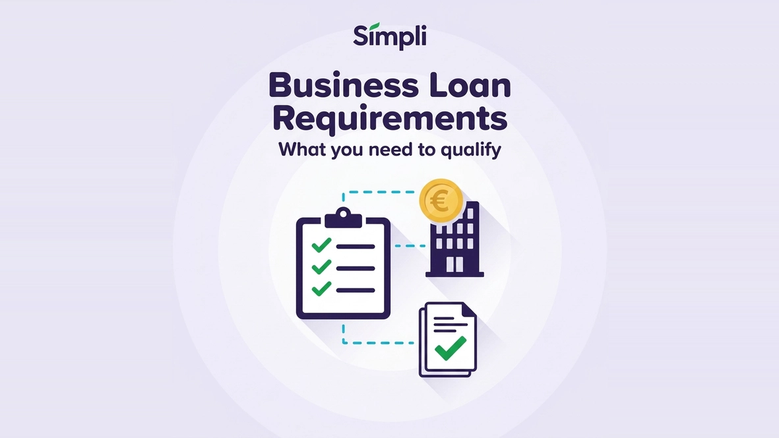
- ✓6 months business bank statements
- ✓Last 2 years of accounts (or management accounts)
- ✓Revenue Commissioners tax clearance certificate
- ✓CRO certificate of incorporation + director IDs
- ✗Tax clearance expired or not yet renewed
- ✗Accounts more than 18 months old. Need management accounts
- ✗Personal bank statements not included for sole traders
- ✗CRO annual returns not filed for current year
How Requirements Differ by Lender
Banks, AIB, Bank of Ireland, PTSB, have the strictest requirements. They typically want two years of accounts, six months of business bank statements, a current Revenue tax clearance certificate, and full CRO compliance. They'll run a comprehensive CCR check and may ask for more detail above certain loan amounts. The process is thorough and takes time, but therates on a bank term loan are the best available for qualifying businesses.
Alternative and fintech lenders are lighter touch. Most want three to six months of bank statements and basic ID. They generally don't require accounts: they assess affordability straight from your bank statement data, which makes them accessible to businesses that don't yet have two years of filed accounts. Revenue compliance still matters, mind: most will check for outstanding tax liabilities even if they don't demand a formal clearance certificate.
CCR: The Irish Credit Register
The Central Credit Register (CCR) is the main credit reference mechanism in Ireland. Every lender is required to check it for any loan application, and most report your loan performance back to it monthly. The CCR holds information on all loans over €500, business and personal, taken by Irish residents since June 2018.
You can check your own CCR for free at centralcreditregister.ie. The report shows all active and closed loans, your payment history, and any defaults or arrears. Review it before you apply and correct anything that's wrong: errors do happen, and you have the right to dispute incorrect entries with the Central Bank.
Revenue Compliance
Revenue Commissioners compliance is non-negotiable for every mainstream Irish lender. That means all VAT returns filed, all income tax or corporation tax returns submitted, and everything owed either paid or under an agreed payment plan. A current tax clearance certificate, available through Revenue's ROS or myAccount portal, is the standard way to prove it.
Outstanding Revenue debt is one of the most common reasons applications get declined. Even a relatively small VAT liability can block you. If you've got a Revenue payment arrangement in place, that's generally fine with lenders, but you have to disclose it and provide documentation confirming the arrangement.
Why Applications Are Rejected
The most common reasons for rejection? Outstanding Revenue debt, CCR defaults or recent missed payments, insufficient trading history for the loan type, accounts that are too old or missing, and asking for more than the business can clearly service. Know these failure points before you apply and you can either fix them in advance or choose a lender with different criteria.
FAQ: Business Loan Requirements Ireland
What is the minimum trading history required for a business loan in Ireland?
Most mainstream lenders require a minimum of 12 to 24 months of trading history. Alternative lenders typically require 6 months of trading with consistent bank statement activity. Microfinance Ireland will consider businesses from as early as one month of trading, provided a business plan and financial projections are submitted.
Do I need to provide personal bank statements for a business loan?
For sole traders, yes. Lenders typically want to see both business and personal bank statements, as the finances of the business and the individual are closely linked. For limited companies, personal bank statements are not always required, but banks often ask for them if the company's business account does not show sufficient activity or if the loan is personally guaranteed.
What is a Revenue tax clearance certificate and where do I get one?
A tax clearance certificate is issued by Revenue to confirm that a business has no outstanding tax liabilities. You can apply for one online through Revenue's myAccount or ROS (Revenue Online Service) portal. The certificate is valid for 12 months. Most lenders require a current tax clearance certificate as part of any loan application.
Can requirements be waived if I offer security?
Offering security, such as property or assets, can strengthen an application and may allow a lender to approve a larger amount or a longer term. However, it does not typically waive the core documentation requirements. Revenue compliance, CCR checks, and trading history requirements are generally non-negotiable regardless of whether security is offered.
Getting Application-Ready
Meeting the requirements for a business loan in Ireland really comes down to preparation. The businesses that get approved fast, at the best rates, are the ones that turn up with clean documentation, current Revenue compliance, and a clear repayment case. None of that is hard: it just takes a bit of planning, which is exactly what ourstep-by-step application guide is for.
At Simpli Finance, we run a pre-application assessment for every client, spotting any documentation gaps or eligibility issues before a formal application goes in. It significantly improves approval rates and speeds the whole thing up.
Get in touch today. The first call is free, and there's no obligation.