Revenue Based Lending vs Merchant Cash Advance: What Is the Difference?

Gary Grimes
CEO & Founder | Head Of Revenue at Simplí Finance
Published:
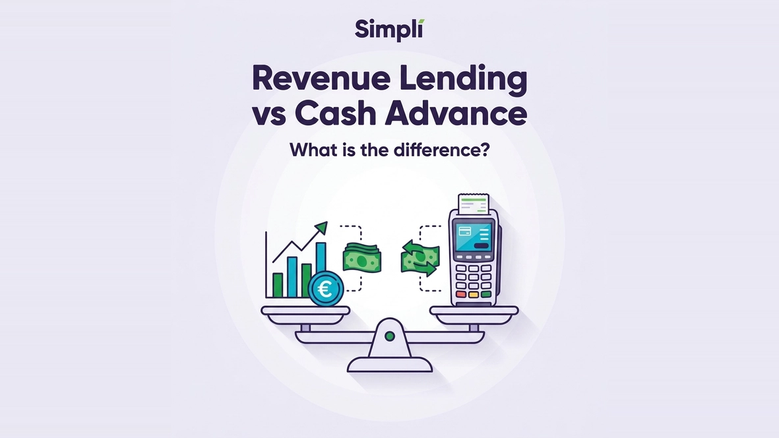
Revenue based lending and merchant cash advance are often used interchangeably in Ireland. They are closely related products but there are important differences between them that affect which one is right for your business.
At Simpli Finance, we are regularly asked to explain the distinction. This guide covers exactly that: how they work, where they differ, and which one suits different types of Irish business.
What Is the Difference Between Revenue Based Lending and a Merchant Cash Advance?
Both products are a form of alternative business finance where repayments are tied to your income rather than fixed monthly amounts. Both use a factor rate rather than an annual interest rate. Both are typically faster to access than a bank loan and neither requires property as collateral.
The core philosophy is the same: lend against future revenue rather than against assets or a credit file. The difference lies in how that revenue is defined and collected.
The Core Difference: Revenue vs Card Sales
A merchant cash advance is specifically tied to card terminal sales. Repayments are collected as a percentage of daily card transactions. This means repayment only happens on days when your card machine is active, and it scales directly with what your terminal processes.
Revenue based lending is broader. It can include all forms of business income, including invoices, bank transfers, and direct debits, not just card sales. Repayments are typically collected weekly based on total revenue reported, rather than daily from a card terminal.
Which Is Better for Your Business?
If your business is card-heavy, such as a retailer, restaurant, or cafe, a merchant cash advance is often the most seamless option. Repayments happen automatically through your terminal and you never have to think about them.
If your business has mixed payment methods, or if a significant share of your income comes from invoices or bank transfers, revenue based lending gives you a more accurate repayment structure. You are not penalised because your customers pay by bank transfer instead of card.
Repayment Mechanics Side by Side
With a merchant cash advance, a fixed percentage is deducted from your card terminal each day. You do not need to do anything. The deduction is automatic and proportional to what you process that day.
With revenue based lending on a broader income basis, you share your revenue data weekly or monthly and the repayment is calculated from that total. This requires slightly more admin but gives a more complete picture of your business performance.
| Feature | Revenue Based Lending | Merchant Cash Advance |
|---|---|---|
| Repayment Source | All revenue types | Card transactions only |
| Best Suited To | Mixed-income businesses | Card-heavy retailers |
| Flexibility | Broader income basis | Limited to card sales |
| Cost Structure | Factor rate 1.15-1.35 | Factor rate 1.2-1.5+ |
| Approval Basis | Revenue-focused | Revenue-focused |
Who Qualifies for Each?
Merchant cash advances are best suited to businesses processing a meaningful volume through card terminals each month. A minimum of around €10,000 to €15,000 in monthly card sales is typically required.
Revenue based lending on a broader basis suits businesses with at least €15,000 in total monthly revenue across all income sources. The six-month trading history requirement applies to both products.
What Simpli Finance Offers
At Simpli Finance, we work with both structures depending on what fits your business best. We look at how your income is generated and recommend the product that gives you the most appropriate repayment structure for your specific situation.
We do not push one product over another. Our job is to match your business to the right form of finance and explain the difference clearly before you decide.
FAQ: Revenue Based Lending vs Merchant Cash Advance in Ireland
Can I get both at the same time?
No. These are the same class of product and you would not hold both simultaneously. If you are already repaying one, a top-up may be possible depending on your profile.
Is one cheaper than the other?
The cost structure is similar for both. The factor rate applied depends on your revenue and risk profile rather than which product label is used.
What if I switch from card to invoice-based income?
That is worth discussing with your lender. If your revenue mix changes significantly during the repayment period, it can affect how repayments are collected and we recommend flagging it proactively.
Does the product name matter for my accountant?
Both products are treated similarly for accounting purposes in Ireland. Your accountant should be familiar with both. The key figure for your accounts is the total repayable amount and the factor cost.
Which is faster to get approved?
Approval speed is similar for both because the assessment process is the same. At Simpli Finance, we aim for a fast decision for either product.
Conclusion
Revenue based lending and merchant cash advance are closely related but the right choice depends on how your business generates income. Card-heavy businesses often suit a merchant cash advance. Businesses with mixed payment methods often suit the broader revenue based structure.
At Simpli Finance, we will tell you clearly which product fits your business and why. There is no pressure to pick one or the other.
Get in touch today and we can walk you through both options in plain language.