Why Business Loan Applications Get Stuck in 2026 (It’s Not Credit, It’s Documents)

Katelyn Hearns
Lending & Operations Manager at Simplí Finance
Published:
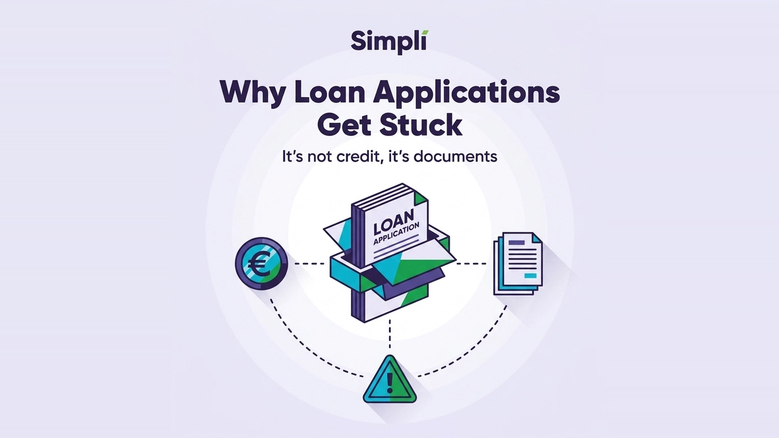
Why Business Loan Applications Get Stuck in 2026 (It’s Not Credit, It’s Documents)
A common reason we struggle to get clients funding… and it’s not what you think.
Most applications don’t stall because a lender is “slow.” They stall because the lender can’t progress the file until the documents are complete, consistent, and in the right format.
I’ve worked on both sides of the industry, in the funder and now the broker. The pattern is constant: the document stage creates delays, stress, and avoidable back-and-forth that pulls business owners away from running the business.
Simplí’s job is to remove that friction and make the process feel simple and controlled.
What you’ll learn
- What document collection really is (and why it blocks approvals)
- The CRO/Revenue issues that get discovered too late
- The #1 bottleneck: bank statements (and what lenders actually need)
- Why Open Banking shouldnt be feared, and how it eliminates statement chaos
Read on.
What “document collection” really means in a business loan application
Document collection isn’t admin. It’s the evidence stage of lending.
A lender needs enough information to answer four questions:
- Is the business real and actively trading?
- Can it afford repayments?
- What other debt/commitments exist?
- Do the numbers reconcile across bank data, tax, and filings?
From the broker side, the challenge is that document requirements change depending on risk. They can vary based on loan size, product type, term, business age, sector, and existing borrowing.
So the owner thinks they’re applying for “a loan.” In practice, they’re supplying proof so the lender can make a decision.
Why document requests feel overwhelming for business owners
Business owners don’t fail document collection because they’re careless. They fail because the process is designed around lenders, not reality.
Typical friction points:
- the list feels like a foreign language
- too many requests arrive at once, with no prioritisation
- accountants and bookkeepers aren’t always aligned with urgency
- owners feel intimidated by finance and don’t want to look uninformed
This is where Simplí must earn its name. We don’t forward a long checklist. We translate, prioritise, and standardise.
The Simplí approach: “Simplí DocSprint”
- Simplífy the list into plain English and clear priorities
- Standardise submissions so lenders can assess immediately
- Remove bottlenecks (including Open Banking where possible)
The hidden CRO and Revenue problems that delay funding
A common shock for clients: they don’t realise they have a CRO or Revenue issue until we flag it during internal checks.
CRO: filings get returned more often than people think
The CRO itself publishes common filing errors and highlights that submissions can be returned due to errors. (CRO)
When lenders run checks and something doesn’t reconcile (company details, filings, dates), the file can stall while it’s corrected.
Reality: these fixes can take weeks (sometimes longer) depending on what needs to be amended and how quickly advisors can act.
Revenue/Compliance: it’s not always “non-compliance”, it’s access and process
Even where a business is compliant, delays happen when owners can’t quickly retrieve what’s needed, or when there are workflow issues inside the tax/admin pipeline.
The #1 bottleneck: bank statements (and why they’re submitted wrong)
If I had to pick one document that causes the most delays: bank statements.
What we regularly receive:
- hundreds of screenshots instead of statements
- missing days/pages
- multiple accounts split across random files
- incomplete date ranges
- four separate accounts with no clear labelling
What a lender needs is consistent, auditable data they can read quickly. When the data is fragmented, underwriting stalls and the file goes back-and-forth.
And the worst part: banks often have delays generating historical statements, so a simple “can you resend this properly?” turns into a multi-week bottleneck.
Open Banking: the clean fix (and why it’s not a scam)
Open Banking is the most effective way to eliminate statement chaos.
Under PSD2, there are regulated providers called Account Information Service Providers (AISPs) that can gather account information with the customer’s consent. (Central Bank of Ireland - English)
This is built around explicit consent and secure access. (Open Banking Standards)
AIB’s own Open Banking FAQs define an AISP as a provider that gathers information from one or more payment accounts and can consolidate that information with your consent. (AIB)
Bank of Ireland describes PSD2’s purpose as increasing competition/innovation/transparency while enhancing security of internet payments and account access. (Bank of Ireland Group Website)
The common client reaction: “This looks shady.” That reaction is normal, it’s unfamiliar. But unfamiliar isn’t unsafe.
Practical explanation for owners:
- You approve access through your bank’s normal authentication flow
- Access is permission-based (you control it)
- It’s designed for secure account data sharing under PSD2 frameworks (Central Bank of Ireland - English)
Not every lender uses it yet, but where it’s available, it can remove the biggest document bottleneck.
If you want faster approvals and fewer headaches, do this in order.
Step 1: Get bank statements right (first time)
- Provide PDF bank statements (not screenshots)
- Cover the required date range (typically last 6 months unless told otherwise)
- Include all business accounts used for trading
- Ensure no gaps, missing pages, or partial months
- Name files clearly: BankName_AccountName_MonthYear.pdf
Step 2: Pre-check CRO before you apply
- Confirm filings are up to date and details match reality
- Fix obvious errors early (CRO highlights common filing errors that cause returns) (CRO)
Step 3: Pre-check Revenue access and readiness
- Ensure you can retrieve the documents lenders typically request quickly
- Don’t discover “we can’t access that” mid-application
Step 4: Use Open Banking if the lender supports it
This can remove the statement chase entirely, because AIS is designed to allow account information services with explicit consent. (Open Banking Standards)
Step 5: Let Simplí run the process
We simplify the list, set the submission standards, and catch issues early so you don’t lose weeks.
Alternatives if you can’t produce perfect documents fast
If timing is urgent and your documents are messy, you still have options, but there are trade-offs.
- Revenue-based / working capital products: speed, typically higher cost
- Staged approach: smaller facility now, better terms later once documents are cleaned
- Secured lending: can improve pricing, but adds extra steps (security/valuation)
The right route depends on urgency, margins, and the strength of the financials.
Conclusion: documents don’t just slow deals, they decide outcomes
If your funding keeps dragging, stop blaming “lenders being slow.” The most common blocker is document quality and consistency, especially bank statements, plus unexpected CRO/Revenue issues discovered too late.
If you want approvals to move quickly:
- standardise statements properly
- pre-check CRO/Revenue early
- use Open Banking where available
- use a broker who actually simplifies (not one who forwards a massive checklist)
Ready to get strategic about your funding? Book a free consultation with Simpli Finance and let’s make invoice finance work for you in 2026 and beyond.