Farm Finance Ireland: Land, Machinery and Seasonal Cash Flow (2026)

Alan Bermingham
10 Years in non banking finance
Published:
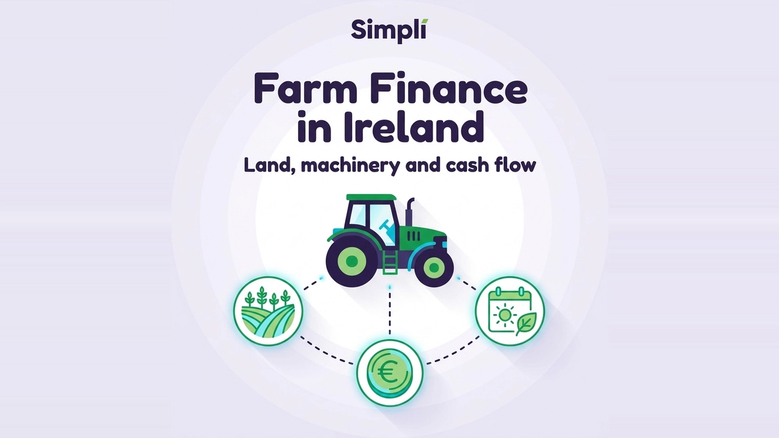
Farming runs on a calendar that no bank manager's spreadsheet really fits. You spend in spring and get paid in autumn, and that six-month gap is where a lot of farm finance comes unstuck, long before anyone looks at the land, the herd or the grant cheques underwriting it all.
What they miss is that farming is one of the most predictable, renewable businesses going. You have land as collateral, a hundred year family track record and government supports underwriting the worst of the downside. So let's lay it out.
This guide covers exactly how farm financing works in Ireland in 2026, which lenders suit land versus machinery versus a quiet seasonal quarter, and what you need to walk in prepared and walk out approved.
- Land loans run over 10 to 15 years and machinery finance over 5 to 7, so you match the repayment term to the life of the asset.
- Seasonal working capital lines bridge the gap between spring inputs and harvest, and you only pay interest on what you actually draw.
- SBCI-backed loans run from €5,000 to €1m with lighter security requirements, and CAP grants can be passed through to repay principal.
- Lenders want a debt service coverage ratio (DSCR) of at least 1.25 from your farm income before they approve.
Why Farmers Get Declined (and How to Avoid It)
Your costs barely move with the season. Feed, fertiliser, labour, vet bills and loan repayments roll in month after month. Your income, though, lands in lumps: a milk cheque, a harvest payment, a mart day for finished cattle. Lenders read that lumpiness as risk, and a lot of them stop reading there.
What they miss is that a working farm is a predictable, renewable business with land sitting behind it as collateral. A 60 cow dairy operation turning over €138,000 a year is more reliable than half the companies that get funded without a second glance.
The job is to present your numbers so the lender sees the renewable income and the asset cover, not just the seasonal swing.
This is exactly where the right asset finance for tractors and machinery, paired with fixed-term business loans for land and seasonal working capital, changes the conversation.
Get this right and the decline reasons disappear. Most farm applications fall down on three things: no 24 month cash flow forecast showing the seasonal variance honestly, no clear DSCR, and ignoring the CAP payments and grants that de-risk the whole picture for a lender.
What Lenders Actually Look For
The metric that matters is the debt service coverage ratio (DSCR), and lenders want your net farm income to cover the annual repayment by at least 1.25 times.
Take the Cork dairy operation above: the blended land and machinery loan at €3,200 a month works out at roughly €38,400 a year to service.
At 1.25 the lender needs to see about €48,000 of net farm income sitting above that, which a 60 cow herd turning over €138,000 a year comfortably clears once costs are out. The difference in agriculture is that no single year settles it.
Underwriters average your income across three to five years precisely because milk price and yields swing, and they fold your CAP basic payment and any coupled supports straight into that income line as a stable, government backed cash flow that counts fully toward serviceability.
Then there is the paperwork that lets the deal through. Your VAT and income tax returns need to be filed and paid, or sitting under an agreed instalment arrangement with Revenue, and you will be asked for a current tax clearance certificate to prove it.
Expect the lender to pull your Central Credit Register file and look for a record that is either clean or clearly under control rather than a string of missed repayments, and if you farm through a limited company your CRO filings need to be up to date too.
On top of the financial checks, an agri lender will want your herd number and confirmation of BPS eligibility, since both anchor the farm and its claim on those supports.
Revenue arrears in particular sink plenty of otherwise viable applications, so settle them well before you sit down with anyone.
The Financing Options That Actually Work
Farm financing is not one product. The right structure depends on whether you are buying land, replacing a tractor, expanding the herd, opening a farm shop, or simply bridging the gap to harvest.
Land and Machinery Loans (€100k to €500k)
Use it when you are acquiring farmland or buying machinery such as tractors, slurry spreaders or sprayers. The land and equipment are the security, so you repay over 10 to 15 years for land and 5 to 7 for machinery.
A Cork dairy farmer recently funded €200,000 of land, €60,000 of dairy equipment including the milking parlour and storage, €40,000 of machinery and €25,000 of working capital.
Structured as a 15 year land loan plus a 7 year equipment loan, the blended repayment works out at around €3,200 a month.
Seasonal Working Capital (€10k to €40k)
Use it to bridge the gap between spring inputs and the harvest cheque. A tillage farmer spends €30,000 on seed, fertiliser and contractor work in spring, then waits six months for the grain to be sold.
A €30,000 working capital line drawn down in spring and repaid from harvest proceeds smooths the whole year, and the interest only runs on what is actually drawn.
Livestock Financing (€5k to €50k)
Use it to grow the herd. Livestock acts as collateral, secondary to the land, and you repay over three to five years. A beef farmer expanding from 50 to 100 cattle at roughly €200 a head finances the €20,000 cost at 6% over five years, around €377 a month, repaid as the finished stock comes off the farm.
Diversification Loans (€20k to €100k)
Use it to add a new revenue stream such as agritourism, a farm shop or value added products. The money funds the building, equipment and branding.
A dairy farm opening a farm shop and cheese making operation finances €50,000, €30,000 for the building and €20,000 for equipment, at 5.5% over seven years, around €756 a month, repaid out of the new margin.
SBCI-Backed Loans (€5k to €25k)
Use it as a younger farmer or smaller operation needing capital to expand. The Strategic Banking Corporation of Ireland backs these loans with lighter collateral requirements and rates that undercut a standard term loan.
A young farmer starting an organic vegetable operation borrows €15,000 at 6% over five years, around €282 a month, without having to pledge the home farm as security.
How the Lenders Differ
- Pillar banks and agri lenders (AIB, Bank of Ireland, Permanent TSB): the strictest requirements, two years of accounts, six months of business statements, a current tax clearance cert and full CRO compliance. They lend €50,000 to €500,000 over 5 to 15 years at roughly 4.5% to 6%, with dedicated agri teams who understand the cycle. Slow and thorough, but the best rates on a qualifying land or machinery loan.
- Alternative and fintech lenders: lighter touch, assessing affordability from three to six months of statement data rather than two years of filed accounts. Faster, higher rates, and the realistic route for a newer operation or where speed on a machinery deal matters more than the headline rate.
- SBCI-backed lenders: bank level rates with more flexibility on security, running from €5,000 to €1m, which is why they suit first time and young farmers who do not want to pledge the whole farm.
What You Need Before You Apply
Walk in with a five year business plan covering your crop rotation, herd plans or diversification; a 24 month cash flow forecast that shows the seasonal dips and the harvest lumps honestly rather than hiding them; a farm valuation or land purchase agreement; historical yield data if you are taking over an existing farm; your personal credit report and a current tax clearance cert; evidence of farming experience through a CV and references; machinery quotes; and the detail of the CAP payments, young farmer schemes and grants you are eligible to receive.
Negotiate seasonal payment flexibility too, with lighter repayments in winter and heavier ones when the cash is in, and ask whether grant payments can be passed through to knock down principal.
Lenders fund operators who clearly understand their own numbers, so the forecast is doing more work than any other document in the pack.
Final Thoughts
Farm financing works the moment the lender understands the business instead of fearing it.
You are not retail and you are not professional services: your cash flow is seasonal and weather dependent, and read correctly, deeply predictable, with land sitting behind every loan as collateral.
Present the yields, the CAP supports and the seasonal pattern in their language and the risk story flips in your favour.
Set the strategy early. Use a long land loan for the property, a medium term machinery loan for the equipment, and a seasonal working capital line for the gap to harvest.
Get 25% to 30% of the cost together, borrow the rest, and do not buy more land than you can farm properly. Break even on a new operation typically takes six to twelve months and full profitability twelve to twenty four, so plan your cash runway accordingly.
If that is on your radar too, our guide to Government Business Grants is a useful next read.
Frequently Asked Questions
Can I get financed if I am a young farmer?
Yes. SBCI and several banks run specific young farmer schemes with lower rates and easier approval. Prove your farming experience or training, show a clear plan, and back it with the CAP and young farmer supports you qualify for.
Should I buy or rent farmland?
Buy if you will farm it for ten years or more and rates are favourable, because land doubles as long term collateral. Rent if you are starting out or unsure about the long term commitment, and grow your owned acreage as the operation grows.
How do I handle commodity price risk?
Lock in prices with forward contracts before harvest where you can, lean on CAP income supports, and diversify so you are not relying on a single crop or output. Lenders look favourably on a farm that has clearly planned for a price drop.