Revenue Based Lending Pros and Cons for Irish Businesses (2026)

Gary Grimes
CEO & Founder | Head Of Revenue at Simplí Finance
Published:
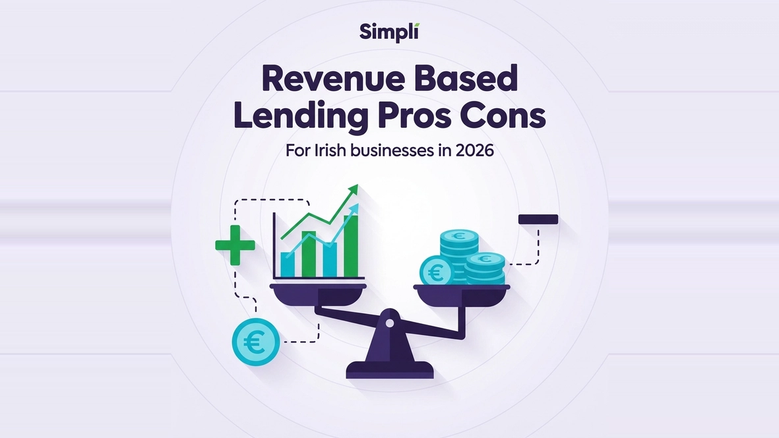
Revenue based lending is not the right product for every business. Like any form of finance, it has genuine strengths and real limitations. Understanding both before you apply means you make the right decision for your specific situation.
At Simpli Finance, we work with Irish business owners every day and we believe in giving people the full picture before they commit to anything. Here is an honest look at the pros and cons of revenue based lending in Ireland.
The Main Advantages of Revenue Based Lending
Repayments flex with your revenue. This is the single most valuable feature for most businesses. If sales are strong, you repay faster. If there is a quiet period, your repayment drops automatically. You are never making a payment your cash flow cannot support.
Speed is another major advantage. At Simpli Finance, we give most applicants a fast decision and funds arrive within five business days. A bank loan application can take weeks or months, with no guarantee of approval at the end.
There is no property collateral required. For business owners who do not own property, or who do not want to put their home at risk, this is significant. The advance is secured against future revenue, not assets.
- ✓Repayments flex with your revenue
- ✓No fixed monthly payment
- ✓No collateral required
- ✓Approved on revenue, not credit score
- ✓24hr decision, 5 days to funds
- ✗Higher cost than a bank loan
- ✗Not suited to early-stage startups
- ✗Factor rate can be opaque
- ✗Repayment timeline is variable
- ✗Requires 6+ months trading history
The Drawbacks You Should Know About
The factor rate model means the total cost is fixed regardless of how quickly you repay. Unlike a traditional loan where repaying early saves you interest, paying down a revenue based advance early does not reduce the total amount owed. The cost is agreed upfront.
The daily or weekly repayment deduction can feel restrictive during a slow period, even though it is proportionally smaller. If your margins are tight, any deduction from revenue requires careful cash flow planning. This is worth thinking through before you apply.
Revenue based lending typically involves smaller advance amounts relative to what a bank might lend to a well-established business. If you need several million euro in capital, a bank loan or other structured finance is likely more appropriate.
Who Benefits Most from This Type of Finance
Businesses with consistent monthly revenue are the strongest fit. Retailers, restaurants, cafes, professional services firms, and e-commerce businesses with regular income tend to find revenue based lending straightforward and well suited to how they operate.
Business owners who have been turned down by a bank but are trading well are also a strong fit. The assessment is based on revenue performance rather than credit history or collateral, which opens up access to a lot of businesses that the banking system has closed the door on.
Who Should Consider Other Options
Early-stage businesses with less than six months of trading history are not a fit for revenue based lending. The product relies on proven revenue, and a business that has not yet established a track record cannot demonstrate the repayment capacity the lender needs to see.
Businesses with very thin margins should think carefully before taking on any form of finance with a daily revenue deduction. The repayment is proportional, but if your margin is already under pressure, even a small percentage makes a difference. We always discuss this with clients before they apply.
How It Compares to a Term Loan
A term loan gives you a fixed lump sum with fixed monthly repayments over an agreed term. This suits businesses with predictable, stable income that can commit to the same payment each month regardless of trading conditions.
Revenue based lending suits businesses with variable income who value flexibility over certainty. The total cost may be higher than a term loan for the same amount, but the flexibility and speed of access often justify the difference.
FAQ: Revenue Based Lending Pros and Cons for Irish Businesses
Is revenue based lending more expensive than a bank loan?
The cost is typically expressed differently, as a factor rate rather than an interest rate, which makes direct comparison tricky. For many businesses the speed and flexibility justify the cost. We walk every client through the numbers.
What happens if my revenue drops significantly?
Your repayment drops with it. That is the key protection built into the product. However, if revenue drops severely for a sustained period, you should speak to your lender as early as possible.
Can I take a payment holiday?
Payment holidays are not a standard feature of revenue based lending. The repayment is automatic and proportional to your revenue. In exceptional circumstances, some lenders will discuss adjustments.
Does it affect my ability to get other finance?
An existing revenue based advance is a liability that other lenders will see. It does not automatically prevent you from accessing additional finance but it is a factor in any future assessment.
Is revenue based lending regulated in Ireland?
The regulation of alternative finance in Ireland continues to develop. Simpli Finance operates responsibly within the Irish lending market. We recommend seeking independent advice if you are unsure whether any product is right for your circumstances.
Conclusion
Revenue based lending is a genuinely useful product for the right business. Flexible repayments, fast access, and no collateral requirement are real advantages. The fixed total cost and daily deduction are real trade-offs worth understanding before you apply.
At Simpli Finance, we give every client an honest assessment of whether this is the right product for their business before they commit to anything.
Get in touch with the team today if you want to talk through whether revenue based lending makes sense for your situation.