Revenue Based Lending vs Bank Loan: Which Is Better for Irish Businesses?

Gary Grimes
CEO & Founder | Head Of Revenue at Simplí Finance
Published:
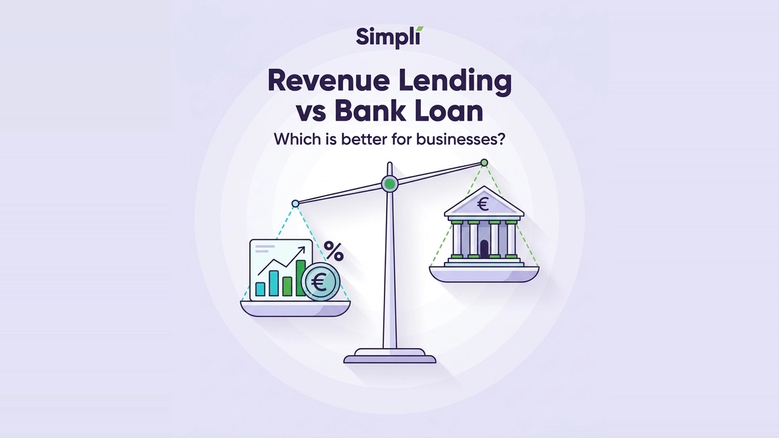
When an Irish business owner needs capital, two of the most common options are a bank loan and revenue based lending. They are very different products and the right choice depends almost entirely on the nature of your business and your cash flow.
At Simpli Finance, we are regularly asked to explain the difference clearly. This guide does exactly that: how each product works, where the key differences lie, and which is likely to be the better fit for your situation.
What Is the Difference Between Revenue Based Lending and a Bank Loan in Ireland?
A bank loan gives you a fixed lump sum upfront. You repay it in fixed monthly instalments over an agreed term, typically between one and seven years. The monthly repayment is the same whether your business is having a strong month or a difficult one.
Banks assess your application based on your credit history, your balance sheet, and in many cases your property as collateral. The process can take weeks or months and approval is not guaranteed even for well-run businesses.
How Revenue Based Lending Works
Revenue based lending also gives you a lump sum upfront. The difference is in how you repay it. Repayments are collected as a percentage of your weekly or daily revenue, not as a fixed monthly amount. When business is strong, you repay more. When it is quiet, you repay less.
The total cost is expressed as a factor rate rather than an interest rate. You agree the total amount you will repay from the start. The process takes days rather than weeks and does not require property as collateral.
The Key Differences That Matter to Irish SMEs
The most important difference for most business owners is repayment flexibility. A bank loan demands the same payment every month. Revenue based lending adjusts to how your business is actually performing. For seasonal businesses or those with variable income, this is a significant practical advantage.
Speed is another major difference. We give most applicants a fast decision. A bank loan can take many weeks from initial application to drawdown, and there is no certainty of approval throughout that process.
| Feature | Revenue Based Lending | Bank Business Loan |
|---|---|---|
| Decision Speed | Fast | 4-12 weeks |
| Repayments | % of revenue (flexible) | Fixed monthly |
| Collateral | Not required | Often required |
| Credit Score | Revenue-focused | Critical factor |
| Bad Credit OK? | Yes | Rarely |
| Lower Cost | Factor rate 1.15-1.35 | Lower APR (if approved) |
When a Bank Loan Makes More Sense
If you have a strong credit file, own property, and need a very large amount of capital over a long term, a bank loan is often the more cost-effective option. The interest rate on a term loan from a pillar bank can be lower than a revenue based factor rate for the equivalent period.
Bank loans also suit businesses with predictable, stable income that can commit to the same repayment each month without concern. If your cash flow is consistent and your credit profile is strong, the bank should be the first conversation.
When Revenue Based Lending Makes More Sense
Revenue based lending makes more sense when you need capital quickly, when your income is variable, when you do not own property, or when the bank has already said no despite your business trading well.
It also suits businesses that want to preserve their credit lines or avoid putting personal assets at risk. Many Irish SME owners use revenue based lending as a working capital tool while keeping their bank relationship for longer-term structured finance.
Cost Comparison: What You Actually Pay
Comparing costs directly is difficult because the products use different pricing models. A bank loan expresses cost as an APR over a multi-year term. Revenue based lending uses a factor rate applied to the advance amount.
For short-term capital needs of six to twelve months, revenue based lending can be competitive once you account for the speed, flexibility, and lack of collateral. For longer terms, a bank loan with a low interest rate is often cheaper in total cost. The right comparison depends on your specific numbers and your specific situation.
FAQ: Revenue Based Lending vs Bank Loan in Ireland
Can I have both at the same time?
Yes. Many Irish businesses hold a bank loan for long-term capital and use revenue based lending for short-term working capital needs. The two products can sit alongside each other.
Which is better for buying equipment?
Asset finance is often the best option for equipment specifically. Both bank loans and revenue based lending can fund equipment, but a dedicated asset finance product is typically structured more appropriately for that purpose.
Does getting revenue based lending affect my chances of getting a bank loan later?
An existing revenue based advance is a liability that a bank will see. It can affect your debt service ratio. This is worth discussing with your accountant or financial advisor.
How long does each take to access?
Revenue based lending through Simpli Finance typically takes under a week from first contact to funds in your account. A bank loan can take several weeks or longer depending on the bank and the complexity of the application.
What if I need more than €500,000?
Revenue based lending through Simpli Finance goes up to €500,000. For larger amounts, a bank loan, private credit, or equity finance is more appropriate. We can point you in the right direction.
Conclusion
Revenue based lending and a bank loan serve different needs. The bank is often the right answer for large, long-term capital requirements when your credit profile is strong. Revenue based lending is often the right answer for working capital, fast access, and flexibility when your income is variable.
At Simpli Finance, we help Irish businesses understand their options and access the right product for their specific situation.
Talk to our team today and we will give you a clear view of what makes sense for your business.