3 Steps to Get Approved for a Business Loan in Ireland (proven tips inside)

Alan Bermingham
10 Years in non banking finance
Published:
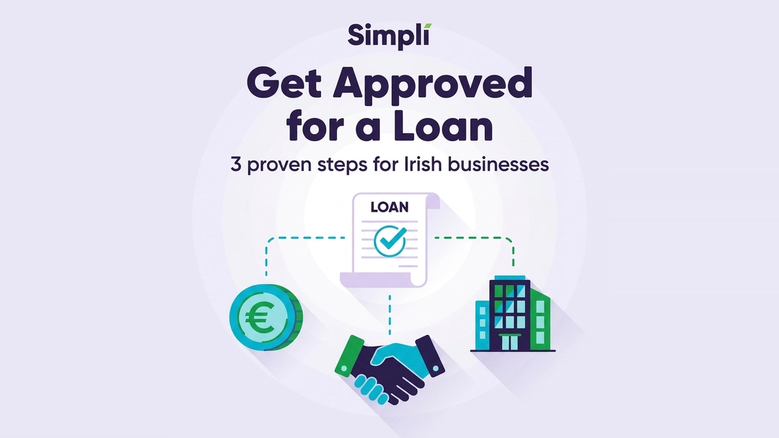
Ever felt like getting a business loan in Ireland is a maze with no map? After a decade helping Irish SMEs secure funding, we've seen it all at Simpli Finance. The nail-biting rejections, the sweet approval calls, and everything in between.
Here's the thing most business owners never hear: lenders assess every application against the same short list. Your debt service coverage, your Central Credit Register record, your tax position and your trading history.
Get those four things right before you apply and approval stops being a lottery. This guide breaks down exactly what lenders check in 2026 and how to strengthen each one before your application ever lands on a desk.
- Lenders want a debt service coverage ratio (DSCR) of at least 1.25x, meaning your net profit covers the repayments with 25% headroom.
- Your Central Credit Register file shows every repayment for the last 5 years, and lenders pull it on every application.
- A current tax clearance cert is the fastest way to prove Revenue compliance, and missing it is one of the most common decline reasons we see.
- Pillar banks want 2 years of trading history, but alternative lenders will assess you on 6 months of bank statements.
What Irish Lenders Actually Assess Before Saying Yes
Every lender we deal with, from the pillar banks to the fintechs, runs your application through the same four filters. Can the business afford the repayments? Has it repaid debt before? Is it square with Revenue? And has it been trading long enough to prove the numbers aren't a fluke?
That's it. The business plan, the projections, the meeting where you pitch your growth story, all of it feeds those four questions.
The good news is that every one of them can be strengthened before you apply. The deals we take to lenders every week that get approved first time aren't from perfect businesses. They're from owners who fixed the weak spots before the lender ever saw them, whether they're applying for fixed term loans or a working capital line.
So let's take each filter in turn.
Step 1: Prove Affordability With a 1.25x DSCR
The metric that decides most applications is the debt service coverage ratio, or DSCR. Lenders want your net operating income to cover the annual loan repayments by at least 1.25 times.
Here's what that looks like in real money. Say you're borrowing €50,000 over five years at around 8%, which works out near €1,014 a month, or roughly €12,170 a year. A lender wants to see about €15,200 of annual net profit sitting above that repayment before they're comfortable.
If your accounts show €25,000 of net profit, you clear it easily. If they show €13,000, you're borderline, and borderline usually means no.
How to strengthen it before you apply:
Run the calculation yourself first. Take your net profit, add back your own drawings if you're a sole trader, and divide by the annual repayment on the loan you want. If you're under 1.25x, either borrow less, stretch the term to bring the repayment down, or wait a quarter and let the numbers improve.
We also see owners boost their DSCR by cleaning up costs in the months before applying. Cancelling unused subscriptions and renegotiating supplier terms sounds small, but €500 a month of savings is €6,000 a year of extra coverage.
One more angle worth knowing: if your profit is lumpy but your turnover is strong, revenue based lending assesses you on sales rather than net profit, and repayments flex with your monthly takings.
Step 2: Get Your Central Credit Register Record Clean
Every lender pulls your Central Credit Register (CCR) file, and it shows five years of repayment history on every loan, overdraft and credit card above €500, both business and personal for directors.
This is the check that catches people out. A missed car payment from three years ago, an overdraft that sat over its limit, a restructure you'd forgotten about. It's all there, and the lender sees it before they see your business plan.
How to strengthen it before you apply:
Request your own CCR report first. It's free from the Central Bank and takes a few days. Read it the way a lender would and look for missed payments, arrears flags or errors.
If you find errors, dispute them and get them corrected before applying. It happens more often than you'd think.
If you find genuine arrears, don't hide from them. Get the account back in order, keep it clean for six months, and be upfront in your application with a one-paragraph explanation of what happened and what changed. Lenders can live with a wobble that's clearly behind you. What they can't live with is finding it themselves after you didn't mention it.
And if your record has real damage, the pillar banks are probably not your route this year. There are lenders who look past a poor file when the trading numbers are strong, and we cover exactly who in our guide to business loans with bad credit.
Step 3: Show Revenue Compliance and Tax Clearance
In our experience this is the single most avoidable decline reason in Ireland. The business is profitable, the credit record is fine, and then the lender asks for a tax clearance cert and the application dies.
Lenders want every VAT and PAYE return filed and either paid or under an agreed instalment arrangement with Revenue. A current tax clearance cert is the simplest proof, and most lenders now ask for it as standard.
How to strengthen it before you apply:
Log into ROS and check your position honestly. If returns are outstanding, file them now, even if you can't pay in full yet.
If you owe Revenue money, agree a Phased Payment Arrangement before you apply, not after. A lender will fund a business that's managing a Revenue debt through a formal arrangement. They won't fund one that's ignoring it.
Then apply for your tax clearance cert through ROS. It's usually instant if you're compliant, and having it ready in your application pack marks you out as an owner who has their house in order.
Tidy paperwork matters more than people think. We've written before about why loan applications get stuck on documents, and tax clearance is the number one culprit.
The Fourth Filter: Trading History (and What to Do If Yours Is Short)
Pillar banks like AIB and Bank of Ireland typically want two years of filed accounts plus six months of business bank statements. That's their comfort zone, and it's why so many younger businesses get an automatic no from their own bank.
But two years is not the only door. Alternative and fintech lenders assess affordability straight from three to six months of bank statement data, so a business trading 12 months with strong monthly revenue is very fundable, just not at a pillar bank yet.
A few ways to work with a short history:
Keep your business banking spotless, because for a young business the bank statements are the accounts. Regular income, no missed direct debits, no gambling transactions, and a balance that doesn't hug zero.
Use supplier credit to build a track record. Negotiating 30 to 60 day terms through trade credit gives you working capital and a repayment history at the same time.
And consider starting smaller. A €15,000 loan repaid cleanly over 12 months does more for your next application than any business plan ever will.
For the full picture of what each lender type expects, our breakdown of business loan requirements in Ireland goes lender by lender.
Common Mistakes That Sink Strong Applications
Rushing the paperwork is the big one. Incomplete or inconsistent documents are a fast track to rejection, because if your numbers don't match across your accounts, statements and application form, the lender assumes the worst.
Applying to the wrong lender is the second. Sending a nine-month-old business to a pillar bank, or asking for a secured loan with no security to offer, wastes weeks and puts a search footprint on your file. If you're not sure which structure fits, our guide to secured vs unsecured business loans is a good starting point.
Scattergun applications are the third. Applying to five lenders at once looks desperate on paper and each rejection makes the next one more likely. Pick the right lender for your profile and make one strong application.
And finally, never let the lender discover something you didn't disclose. Arrears, a Revenue balance, a director's past insolvency. Disclosed with context, these are manageable. Discovered, they're fatal.
Expert Tips for a Smooth Approval
Start your prep 8 to 12 weeks before you need the money. That's enough time to fix a CCR issue, sort tax clearance and let a strong trading quarter land in your accounts.
Build the pack once and build it properly: filed accounts, six months of statements, tax clearance cert, a one-page summary of what the loan is for and how it repays. Lenders fund owners who clearly understand their own numbers.
Be honest about weaknesses before they're found. A short paragraph explaining a bad patch, with evidence it's fixed, turns a red flag into a footnote.
And use a broker's knowledge of the market. We take applications to lenders every week, so we know which lender says yes to a 14-month-old company, which one ignores a historic arrears flag, and which one will decline you in minutes. Matching the application to the right desk is half the approval. The full application process is worth reading before you start.
Final Thoughts
Getting approved for a business loan in Ireland isn't rocket science, but it does take the right prep. Lenders assess four things: affordability at 1.25x coverage, a clean Central Credit Register file, Revenue compliance, and enough trading history for your lender type.
Every one of those can be checked and strengthened before you apply. The businesses we see approved first time aren't the perfect ones. They're the ones that did the homework, fixed the weak spot, and put the application in front of the right lender.
We've seen too many good businesses miss out over small, fixable mistakes. Don't let that be you.
Frequently Asked Questions
What credit score is needed for a business loan in Ireland?
There's no magic number. Ireland uses the Central Credit Register rather than a single score, so lenders read your 5-year repayment history directly. A clean file with no recent missed payments puts you in a strong spot, and for startups the lender leans more on the directors' personal records and the business plan.
How long does business loan approval take in 2026?
Alternative lenders can approve in days when your documents are ready, and pillar banks typically take 2 to 6 weeks. The single biggest factor is your paperwork. A complete pack with accounts, statements and tax clearance moves fast, while missing documents can drag any application out by weeks.
Can startups get approved for business loans?
Yes, but the bar is higher. With no trading history the lender leans on your business plan, cash flow forecasts, the directors' personal credit and usually a personal guarantee. Microfinance Ireland and SBCI-backed schemes are often the realistic first stop before a startup qualifies with mainstream lenders.
What are the main reasons business loans get rejected?
The four we see most are weak debt service coverage, arrears on the Central Credit Register, outstanding Revenue debt with no arrangement in place, and incomplete applications. Nearly all of them are fixable before you apply, and if you do get rejected, ask the lender for feedback and use it on the next attempt.