Convertible Loans & Equity Finance Ireland: Raising Growth Capital (2026)

Alan Bermingham
10 Years in non banking finance
Published:
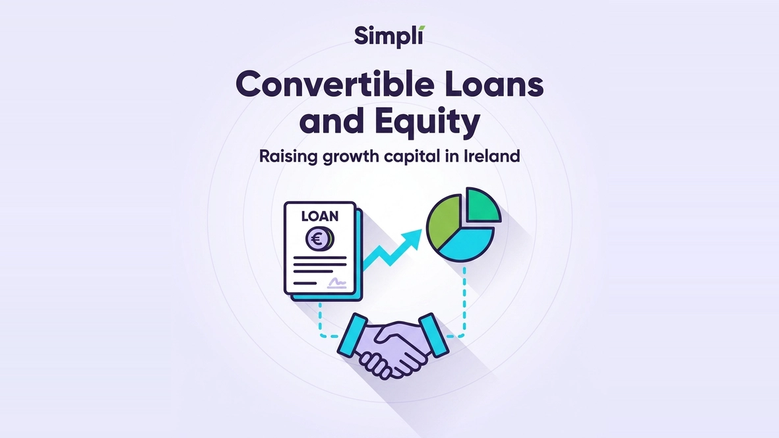
Convertible notes promise the best of both worlds: cash now, valuation later. That neatness hides a lot of moving parts, and founders who raise without understanding the discount, the cap and the dilution can hand away far more of their company than they ever intended.
Here is what you need to know. This guide covers exactly how convertible loans, SAFE notes, equity investment, revenue-based financing and venture debt work for Irish startups in 2026, what investors actually look for, and how to pick the structure that gets you funded without giving away the business.
- A convertible loan lets you raise growth capital now and settle the valuation later, converting to equity at your next funding round.
- Conversion discounts of 20% to 35% reward early backers, but stack the discount with a low valuation and your dilution runs away on you.
- SAFE notes strip out interest and a maturity date, which suits the earliest stage; venture debt suits a post Series A runway extension.
- Equity is not Revenue or Central Credit Register gated the way bank debt is, but investors still expect clean CRO filings and tidy compliance before they wire funds.
Why Growth-Stage Founders Struggle to Raise (and How to Avoid It)
The instinct most founders bring to a raise is to maximise valuation and minimise everything they give away. It feels like winning. In practice it is the single fastest way to box yourself in.
Price the round too high and the next round either marks you down, which spooks the whole cap table, or stalls entirely because nobody wants to back into your last number. Either way the early discount you handed out compounds against you.
The other trap is treating every instrument as the same deal in different wrapping. It is not. A convertible loan is debt today and equity later. A SAFE is neither until a future round decides. Equity is a price set now.
Each one allocates risk between you and your backer differently, and founders who do not run the dilution maths across two or three rounds routinely wake up owning far less than they planned.
Get this right and the struggle disappears. The founders who raise cleanly are the ones who decide what they are optimising for first, then choose the instrument that delivers it, rather than chasing a headline valuation and discovering the cost a round later.
What Investors and Lenders Actually Look For
Traction is the metric that opens doors: users growing, revenue growing, or a market opportunity so clear the gap reads as obvious. Alongside it sits runway.
Investors want to see that the cheque buys you enough months to hit the milestone that justifies the next round, typically 18 months of cover at your current burn, so a startup spending €15,000 a month is realistically raising around €270,000 plus a buffer.
Raise too little and you are back fundraising before you have proved anything.
Then they read the conversion terms. On a convertible they will scrutinise the discount, the interest rate, the trigger event and whether a maturity date forces a repayment you cannot make. Get the discount and valuation cap wrong and you are giving away equity you never needed to.
Equity finance is not Revenue compliance or Central Credit Register gated the way a bank term loan is, which is one of its quiet advantages for a young company that has not yet built a filing history. But do not mistake that for a free pass.
Investors still run diligence, and clean CRO filings, a tidy share register and properly papered prior agreements all need to be in order before funds move.
Messy compliance does not get you declined the way Revenue arrears would on debt, but it stalls deals and weakens your hand at exactly the wrong moment.
The Growth Financing Options That Actually Work
Growth financing is not one product. The right structure depends on whether you are avoiding a valuation conversation, protecting revenue from dilution, or extending runway after a priced round.
If your model throws off steady revenue, weigh these against revenue-based lending before defaulting to equity, and if you simply need predictable capital, compare them with fixed-term business loans too.
Convertible Loans (€50k to €500k)
Use it when you need growth capital but want to defer the valuation conversation. You borrow the money and, at your next funding round, it converts to equity at a discount; if no round happens, it stays as debt that you repay.
A Dublin SaaS startup raised a €150,000 convertible at 8% interest with a 25% discount, converting on its Series A.
If that Series A values the company at €5M, the loan converts at the discounted €3.75M valuation, handing the holder roughly 2.67% equity plus the interest paid until conversion.
SAFE Notes (€50k to €300k)
Use it when you want capital without interest or a maturity date hanging over you. A SAFE is not a loan; it is an agreement that a future round will set the conversion terms.
A startup raising €100,000 via SAFEs takes no interest obligation and no repayment date, with the notes converting to equity when Series A closes. It is the simplest instrument at the earliest stage, which is exactly why it travels well with angels.
Equity Investment (€100k to €1M+)
Use it when you are ready to trade equity for capital and strategic support. Investors buy shares, own a percentage of the company and potentially take a board seat. An angel putting €200,000 into a startup valued at €2M takes 10% of the business.
The price is set today, so there is no conversion to model, but you give up ownership and a degree of control from day one.
Revenue-Based Financing (€50k to €200k)
Use it when you have revenue and want to avoid dilution entirely. The investor takes a percentage of monthly revenue until they have recouped their capital plus a return, typically 1.3 to 1.5 times.
A SaaS business doing €20,000 a month raises €100,000 and repays at 1.5% of revenue each month until €150,000 is cleared. No shares change hands, and repayments flex with how the month actually went.
Venture Debt (€100k to €500k)
Use it when you have closed a Series A or B and need extra runway without further dilution. It is traditional debt, but on easier terms because a VC is already backing you.
A company that raised a €2M Series A might layer €500,000 of venture debt at 10% to 12% on top to stretch its runway, preserving equity for the founders and existing investors.
How the Options Differ
- Convertible loan: debt now, equity later. You get an interest cushion and downside protection, but a maturity date can force a repayment if no round arrives, so it suits founders confident a priced round is coming.
- SAFE note: no interest, no maturity, no repayment obligation. Simpler and cheaper than a convertible, but it offers the holder less protection and leaves more of the terms to a future round, which is why it fits the very earliest stage.
- Equity: price set today, ownership transferred today. No conversion maths and no debt overhang, but the dilution is immediate and permanent and a board seat may come with it.
- Venture debt: lowest dilution of all, but it is only realistically available once a VC has already priced and backed the company, making it a runway tool rather than a first raise.
What You Need Before You Raise
Walk in with the milestone the cheque is meant to unlock and the maths behind it: your monthly burn, your runway to that milestone and the buffer on top, so an 18-month runway at €15,000 a month frames cleanly as a €300,000 raise.
Bring traction metrics that show users or revenue moving, a team story that explains why you are credible, a conservative financial projection rather than a hockey stick, and a clear use of funds.
Have your CRO filings, share register and any prior SAFE or convertible terms tidy and to hand, because diligence will find the gaps.
And run your dilution across two or three rounds before you sign anything, so you know where founder ownership lands; below 60% before Series A is the line we would not cross without a very good reason.
Final Thoughts
Growth capital is genuinely available to Irish companies with traction, and traction is simpler than founders fear: users growing, revenue growing, or a market opportunity nobody can argue with. The instrument is where deals are won or lost.
Convertibles and SAFEs do their best work at the earliest stage when a valuation is hard to justify; once you have a priced Series A behind you, equity and venture debt become the cleaner tools.
The thread running through all of it is alignment. Pick backers who want to help build, not just extract a return, because you will lean on them as advisors long after the cash has landed.
Structure every round knowing the next one is coming, keep your founder ownership above the floor, and you raise growth capital without ever boxing yourself in.
If it fits your plans, Angel Investment is the natural next guide to read.
Frequently Asked Questions
Convertible loan or SAFE, which is better?
Choose a convertible if you want the interest cushion and the downside protection of holding debt until conversion. Choose a SAFE if you want simplicity, no maturity date and no interest, which usually suits the very earliest raise.
What happens if you never raise another round?
A convertible loan stays as debt and you repay it, usually with the accrued interest, at or before the maturity date. A SAFE depends entirely on its terms, so confirm with the investor up front exactly what happens if no priced round ever arrives.
How much dilution is too much?
As a rule of thumb, avoid dropping below 60% founder ownership before your Series A. After Series A, landing somewhere around 40% to 50% is normal, provided you have modelled the next round before you sign this one.